25.3.5 Voyager released
Changes compared to 25.3.4
Changes compared to 25.3.3
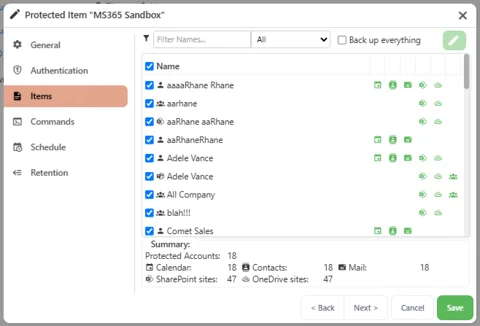
In previous versions of Comet, the "Select all except..." option for Microsoft 365 Protected Items was provided as an alternative way to select accounts, allowing for the automatic inclusion of new accounts and potential exclusion of others. User feedback was that the behaviour of this option was unintuitive, and so we have elected to remove this option in favour of a more intuitive alternative.
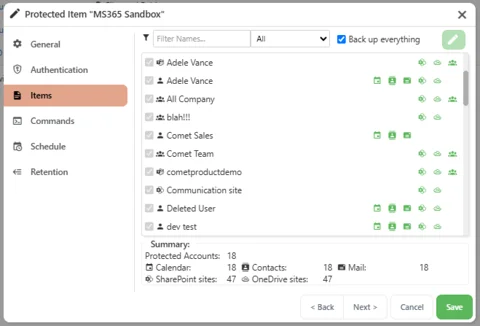
In Comet 25.3.4, we are introducing the new "Back up everything" option for Microsoft 365 backups. This option provides a simple way to back up everything within a domain, including any accounts that are added later.


To back up everything with exceptions, users should instead create a group in Microsoft 365 and have the group auto-assign to new accounts. Users to be excluded can be removed from the group, and this group can then be selected in Comet.
Changes compared to 25.3.2
Comet uses a custom Linux kernel driver backupsnap61 to snapshot a block device during a Linux Disk Image Protected Item backup.
In previous releases, backupsnap61 had to be installed manually using the backupsnap61-install.sh script found in the Comet Backup install directory.
Without backupsnap61 installed, Comet can't guarantee it can get exclusive read access to a block device. This will appear as a warning in a Linux Disk Image backup job log.
Now, backupsnap61 is installed automatically by Comet to ensure a snapshot driver is always available before starting a Linux Disk Image backup.
Changes compared to 25.3.1
Creating the Linux recovery environment ISO using Comet Backup on a Linux endpoint can now be done without requiring Docker to be installed. This simplifies the install requirements to build the Linux recovery environment and also reduces how long it takes to build the recovery environment.
VMware Protected Items that have been configured to use the Latest VM state (Changed Block Tracking) mode will now fallback to performing a full VM backup when Comet detects that more than 50% of the disk has changed. This speeds up the backup peformance when large parts of the VM has been modified.
Changes compared to 25.2.0
As part of our efforts to improve the experience of using Comet, in Comet 25.3.0 we have added functionality to automatically change Storage Vault access keys for some of our supported storage providers, allowing admins to manually unlock compatible Storage Vaults without the risk of data loss.
Vaults can also be automatically unlocked when specified criteria, configured in user policy settings, have been met.
The following Storage Vault types are currently supported:

Comet 25.3.0 adds support for setting yearly schedules and retention rules - great for long term storage, archival, and compliance requirements.


Changes compared to 24.12.5
As part of our efforts to improve the usability of Comet, all Comet Server Roles have been renamed.
These changes better reflect the capabilities of each role making it easier for new and existing customers to understand what each role does.
As part of this change, the Comet Server Service Manager (CSSM) has been renamed to the Comet Core Service Manager (CCSM).
The Comet Server web interface has also been update to reflect this changes, grouping the related side menu pages and settings under each of the new names.


Self-Hosted Comet Management Console Only
Storage Templates are Comet's recommended way to configure and deploy Storage Vaults for your backup infrastructure. Findng the Storage Templates settings on a Self-Hosted Management Console has been made significantly easier.
In older versions of Comet, the Storage Template settings were found as part of the Management Console (previously Auth Role) settings. This has now been moved to its own settings section which is a lot easier to find.

Changes compared to 24.12.4
Comet 24.12.5 introduces the ability to restore virtual machine Protected Items directly into new Hyper-V virtual machines.
This brings:
Direct restores into Hyper-V is available from the Comet Server web interface and from the Comet Backup desktop app. The following screenshots are from the Comet Server web interface.


NOTE: For direct Hyper-V restores, the Comet Backup desktop app must be running on the same endpoint as Hyper-V is installed on.
Comet 24.12.5 introduces the ability to restore virtual machine Protected Items directly into new VMware (vSphere or VCenter) virtual machines.
This brings:
Direct restores into VMware (vSphere or VCenter) is available from the Comet Server web interface and from the Comet Backup desktop app. The following screenshots are from the Comet Server web interface.


Comet 24.12.5 introduces the ability to restore Disk Image Protected Items directly into a new Hyper-V or VMware (vSphere or VCenter) virtual machines.
This brings:
Disk Image restores into Hyper-V or VMware (vSphere or VCenter) is available from the Comet Server web interface and from the Comet Backup desktop app. The following screenshot is from the Comet Server web interface.

Previously, deleting a default Protected Item from a Policy would delete the Protected Item from all Users and Devices the Policy is applied to. This meant it was impossible to remove the Default Protected Item from the Policy, but keep the Protected Item.
In Comet 24.12.5, new Comet Server web interface dialog prompts have been added to give admins greater control over what Default Protected Items should be kept and should be removed. This means admins can make changes to Policies at any time without impacting the Default Protected Items configured.

Changes compared to 24.12.3
When Comet skips a file during a Microsoft 365 Protected Item Backup, this can be due to the file being reported as Malware by Microsoft 365 or because Comet does not have the correct permissions to access the file. Now, Comet will list the exact URL of the file it failed to backup and list the reason why. This makes it much easier to debug and diagnose why a file was not backed up correctly.
After restoring LVM2 partitions, Comet will now automatically show the new devices in the recovery environment. This means you are able to confirm the Disk Image restore worked as expected without needing to leave the recovery environment.
Changes compared to 24.12.2
Self-Hosted Comet Server Only
To improve secure access to a Comet Server, in Comet 24.12.3 it is now possible to configure allowed IP addresses for admin accounts when logging in. This means Comet will only allow admin logins from a predefined list of IP addresses. These addresses can be configured in the Comet Server web interface.